



VRF vs Centralised Air Conditioning Systems – Which Is Better for Large Buildings?
Large commercial and institutional buildings require air conditioning systems that can deliver consistent comfort, operational reliability, and long-term energy efficiency. Across Tamil Nadu, particularly in commercial hubs such as Coimbatore, two solutions are most often compared for such projects: VRF (Variable Refrigerant Flow) air conditioning systems and centralised air conditioning systems.
Both technologies are proven and widely used, yet they differ significantly in design approach, control capability, energy behaviour, and lifecycle considerations. Understanding these differences helps developers, facility managers, consultants, and business owners select the most suitable system for their building.
Understanding Centralised Air Conditioning Systems
Centralised air conditioning systems generate cooling at a central plant, typically using air-cooled or water-cooled chillers. Cooling is distributed through chilled water piping, air handling units (AHUs), fan coil units (FCUs), and duct networks to serve multiple zones.
Centralised AC systems are commonly installed in:
- Hospitals and healthcare campuses
- Shopping malls and multiplexes
- Airports and transportation hubs
- Universities and institutional campuses
- Large hotels and convention centres
These systems are designed for high cooling loads and continuous operation, making them suitable for buildings with predictable occupancy and steady demand.
Key advantages
- High reliability for large-scale applications
- Stable temperature control across wide areas
- Better integration with ventilation and air quality systems
- Cost efficiency at large tonnage levels
Limitations
- Limited room-level temperature control
- Higher space requirement for plant rooms and services
- Energy efficiency depends heavily on design and load management
Understanding VRF Air Conditioning Systems
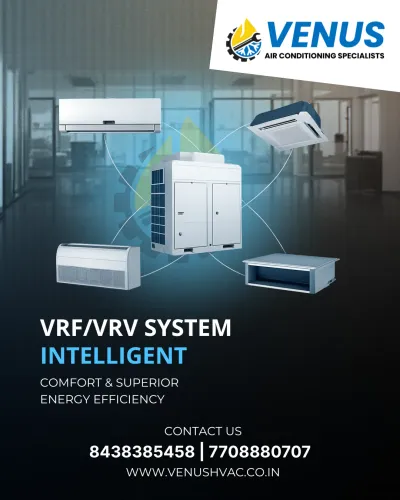
VRF systems use inverter-driven compressors that continuously adjust refrigerant flow based on real-time demand. A single outdoor unit can connect to multiple indoor units, each operating independently.
VRF systems are widely adopted in:
- Corporate offices and IT parks
- Hospitals and specialty healthcare facilities
- Hotels and hospitality projects
- Premium apartments and villas
- Mixed-use commercial developments
VRF technology is particularly effective in buildings with variable occupancy and diverse cooling requirements.
Key advantages
- High energy efficiency at partial load
- Individual zone or room-level temperature control
- Flexible system design and scalability
- Quiet operation and compact installation
Limitations
- Higher initial investment compared to some traditional systems
- Requires experienced design, installation, and commissioning
- Professional maintenance is critical
Energy Efficiency Comparison
Energy efficiency is a major deciding factor in long-term HVAC planning.
Centralised systems perform efficiently when operating near design load. However, in buildings where occupancy varies significantly, efficiency can drop if systems are not optimised for partial load operation.
VRF systems excel under partial load conditions, which are common in offices, hotels, and hospitals. By modulating compressor speed and refrigerant flow, VRF systems reduce energy waste and deliver measurable electricity savings over time.
Control and Zoning Flexibility
Centralised AC systems typically control cooling at zone or floor level. While this is sufficient for large open areas, it offers limited flexibility for buildings with diverse room usage.
VRF systems provide independent control for each indoor unit, allowing different rooms or zones to operate at different temperatures simultaneously. This flexibility improves comfort and reduces unnecessary cooling.
Installation and Space Requirements
Centralised air conditioning requires:
- Dedicated plant rooms
- Space for chillers, pumps, cooling towers
- Extensive piping and ducting
VRF systems require:
- Refrigerant piping networks
- Less mechanical space
- Flexible routing options, especially useful in retrofit projects
The choice often depends on whether the project is a new build or a retrofit.
Maintenance and Lifecycle Considerations
Both systems require structured preventive maintenance.
Centralised AC maintenance focuses on:
- Chiller performance and efficiency
- AHU and pump servicing
- Water treatment and filtration
VRF maintenance focuses on:
- Electronic controls and sensors
- Refrigerant system health
- Indoor unit servicing and diagnostics
In both cases, Annual Maintenance Contracts (AMC) help ensure predictable costs, reduced downtime, and extended equipment life.
Which System Should You Choose?
In practical applications across Coimbatore and other commercial centres in Tamil Nadu:
- Choose centralised AC for very large buildings with continuous, uniform cooling demand such as malls, airports, and large hospitals.
- Choose VRF systems for buildings with variable occupancy, multiple zones, and a need for energy efficiency and flexibility, such as offices, hotels, and premium residences.
Many large developments adopt hybrid solutions, combining centralised systems for common areas and VRF systems for zones requiring independent control.
Importance of Professional HVAC Expertise
The success of both VRF and centralised air conditioning systems depends heavily on professional HVAC design, precise installation, and proper commissioning. Incorrect system selection or poor execution can negate the benefits of either technology.
Working with an experienced HVAC partner such as Venus Air Conditioning Specialist ensures that system selection is based on detailed load analysis, operational needs, and long-term efficiency goals.
Conclusion
VRF and centralised air conditioning systems are both powerful solutions for large buildings, each excelling in different scenarios. The right choice depends on building size, usage pattern, energy strategy, and long-term operational objectives.
With professional planning and execution, either system can deliver reliable comfort, energy efficiency, and long-term value for commercial and institutional projects across Tamil Nadu.