



VRF vs Ducted Air Conditioning – Choosing the Right System for Commercial Buildings
Selecting the right air conditioning system is a critical decision for modern commercial buildings. Among the most commonly evaluated solutions are VRF (Variable Refrigerant Flow) systems and Ducted air conditioning systems. Both technologies are designed for professional environments and long operating hours, but they differ significantly in design philosophy, control flexibility, energy performance, and application suitability.
Understanding these differences helps building owners, facility managers, architects, and consultants choose a system that aligns with operational needs, comfort expectations, and long-term cost efficiency.
Venus Air Conditioning Specialist provides professional design and execution support for both VRF and ducted air conditioning systems across a wide range of commercial and institutional projects.
What Is a VRF Air Conditioning System?
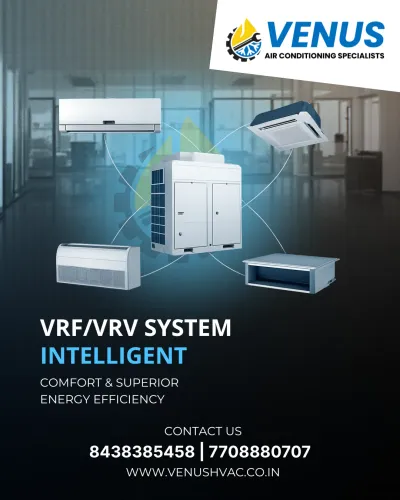
A VRF system uses inverter-driven compressors that continuously adjust refrigerant flow based on real-time cooling demand. A single outdoor unit can connect to multiple indoor units, each operating independently.
Key characteristics of VRF systems:
- Individual temperature control for each room or zone
- High energy efficiency during partial-load operation
- Flexible indoor unit options (wall-mounted, cassette, ducted)
- Stable cooling with minimal temperature fluctuation
VRF technology is commonly used in offices with multiple cabins, hotels, hospitals, educational institutions, and mixed-use commercial buildings where zoning flexibility is essential.
What Is a Ducted Air Conditioning System?
A ducted air conditioning system uses a centralized indoor unit that distributes cooled air through insulated ducts and ceiling diffusers. These systems are designed to provide uniform airflow across large areas or zones.
Key characteristics of ducted systems:
- Even cooling across open spaces
- Concealed installation with clean interiors
- Centralized or limited-zone control
- High airflow capacity for large floor areas
Ducted air conditioning is widely applied in open-plan offices, retail showrooms, banquet halls, restaurants, and commercial floors where consistent temperature is preferred.
VRF vs Ducted AC – Key Comparison Factors
1. Zoning and Temperature Control
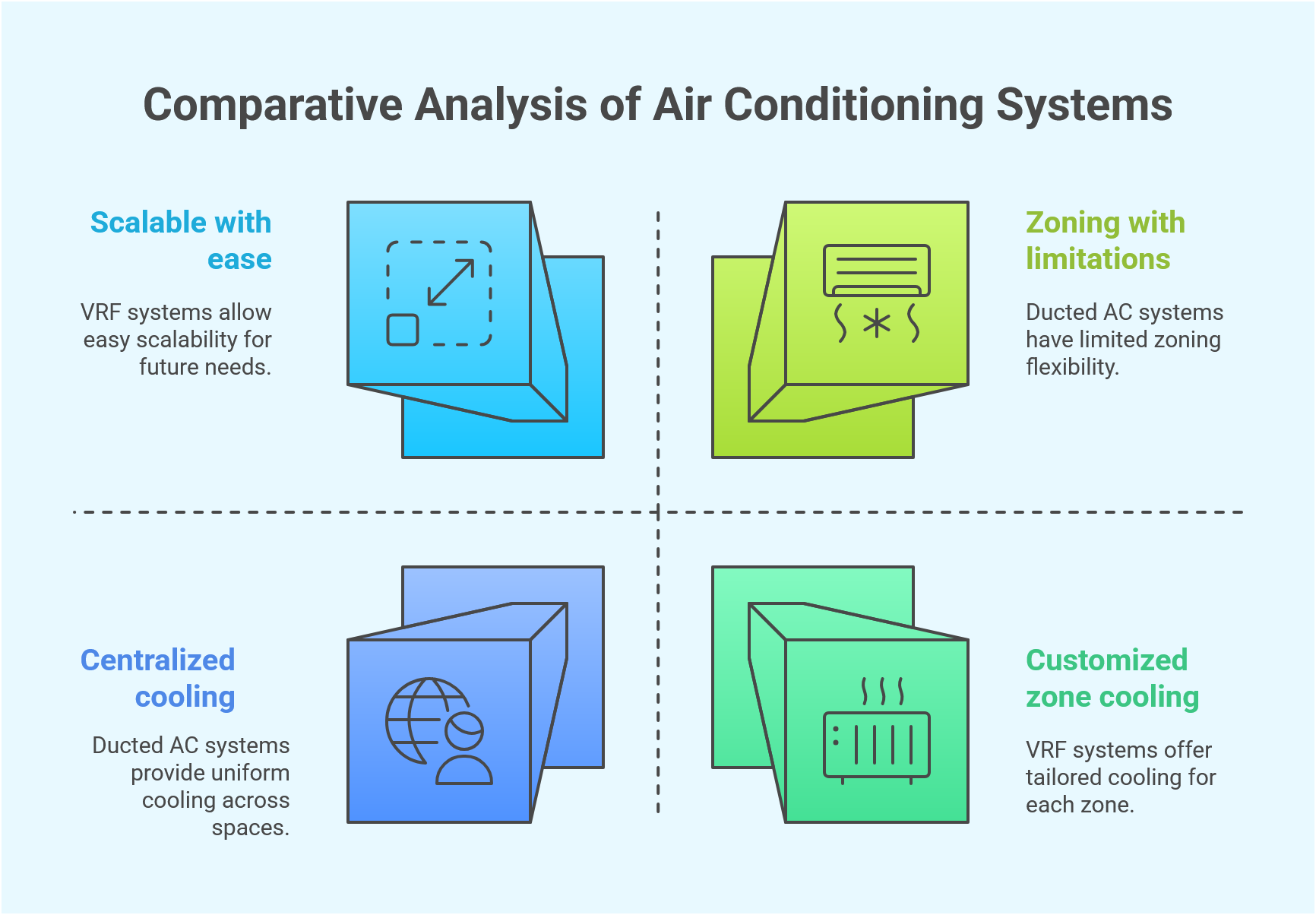
VRF systems allow independent control of each indoor unit, making them ideal for buildings with varied usage patterns.
Ducted systems generally cool entire zones uniformly, with limited flexibility unless advanced zoning is implemented.
2. Energy Efficiency
VRF systems are highly energy-efficient due to inverter technology and excellent part-load performance. Energy savings of 30–40% are common in variable-occupancy buildings.
Ducted systems are efficient for large open areas but can consume more energy if operated continuously without zoning control.
3. Application Suitability
VRF is best suited for:
- Multi-room offices
- Hotels and healthcare facilities
- Buildings with varying occupancy
Ducted AC is best suited for:
- Open commercial spaces
- Retail and showroom environments
- Large halls and floor plates
4. Installation and System Design
VRF systems require precise refrigerant piping design, electronic controls, and skilled commissioning.
Ducted systems require accurate duct design, insulation, and airflow balancing to perform efficiently.
Both systems demand professional HVAC design to avoid performance and energy issues.
5. Noise and Comfort
Both systems offer quiet operation when installed correctly. VRF indoor units are particularly suitable for cabins and conference rooms due to very low noise levels. Ducted systems minimize noise by locating the indoor unit away from occupied areas.
Cost Considerations: Initial vs Lifecycle Cost
VRF systems typically involve a higher initial investment, but they offer lower operating costs over time due to superior energy efficiency and zoning control.
Ducted systems may have a lower upfront cost for large open spaces, but lifecycle cost depends heavily on operating hours, control strategy, and maintenance quality.
Evaluating total cost of ownership is more important than comparing initial prices alone.
Importance of Professional HVAC Design
Choosing between VRF and ducted air conditioning should always be based on:
- Heat load calculation
- Building layout and zoning needs
- Occupancy pattern
- Operating hours and energy goals
Incorrect system selection or poor design can result in discomfort, higher electricity consumption, and frequent service issues.
Professional HVAC engineering ensures the selected system delivers long-term reliability and efficiency.
Service, Maintenance, and AMC Considerations
Both VRF and ducted systems require structured preventive maintenance to sustain performance. Regular servicing includes:
- Filter and coil cleaning
- Electrical and control inspection
- Refrigerant or airflow checks
- Performance testing
Annual Maintenance Contracts (AMC) help ensure predictable maintenance costs and uninterrupted system operation.
Conclusion
Both VRF and ducted air conditioning systems are proven solutions for commercial buildings when applied correctly. VRF systems excel in flexibility, zoning, and energy efficiency, while ducted systems deliver powerful, uniform cooling for large open spaces.
The right choice depends on building usage, layout, comfort expectations, and long-term operating strategy. With professional HVAC design and execution, either system can deliver reliable, efficient, and comfortable indoor environments for commercial applications.
Need Expert Guidance?
For system comparison, HVAC design support, installation, service, or AMC planning, consult an experienced HVAC specialist to evaluate the most suitable solution for your project.