



VRF vs Ducted Air Conditioning for Offices – Which System Delivers Better Value?
Office environments demand air conditioning systems that provide consistent comfort, energy efficiency, low noise, and reliable operation over long working hours. Across Tamil Nadu, particularly in growing business districts such as Coimbatore, two solutions are most often evaluated for office projects: VRF (Variable Refrigerant Flow) systems and ducted air conditioning systems.
Both systems are widely used in modern offices, yet they differ in design philosophy, control flexibility, installation requirements, and long-term operating costs. Understanding these differences helps organisations select the most suitable solution for their office layout and usage pattern.
Understanding VRF Air Conditioning for Offices
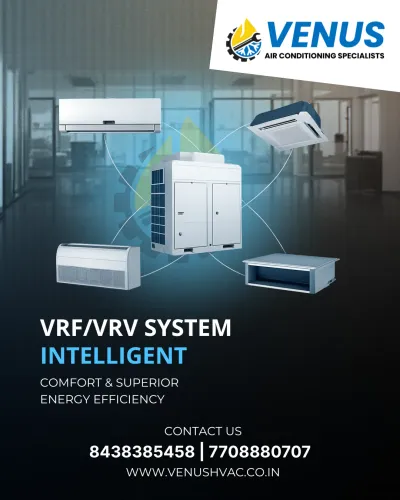
VRF systems connect multiple indoor units to a common outdoor unit. Each indoor unit operates independently, allowing different rooms or zones to maintain different temperature settings at the same time.
VRF systems are commonly installed in:
- Corporate offices with multiple departments
- IT parks and technology centres
- Business centres and co-working spaces
- Multi-floor office buildings
Key advantages of VRF systems
- High energy efficiency, especially during partial load operation
- Individual temperature control for each room or zone
- Quiet operation suitable for work environments
- Flexible design for phased expansion or retrofits
VRF systems perform particularly well in offices where occupancy varies across rooms and throughout the day.
Understanding Ducted Air Conditioning for Offices
Ducted air conditioning uses a concealed indoor unit connected to ducts that distribute cooled air through diffusers. Only grilles are visible, giving offices a clean and uniform appearance.
Ducted AC systems are widely used in:
- Offices with multiple cabins and meeting rooms
- Corporate headquarters
- Administrative buildings
- Institutional offices
Key advantages of ducted systems
- Uniform cooling across multiple rooms
- Clean interior aesthetics with concealed equipment
- Low noise levels
- Centralised control for entire office zones
Ducted systems are ideal for offices where layout is fixed and uniform cooling is required throughout working hours.
VRF vs Ducted – Key Comparison for Office Applications
Energy efficiency
VRF systems adjust compressor speed based on demand, making them highly efficient in offices with variable occupancy. Ducted systems can be efficient when properly designed but are less flexible during partial load operation.
Zoning and control
VRF provides independent control for each room or department. Ducted systems generally offer central or limited zoned control.
Installation flexibility
VRF systems use refrigerant piping and require less ceiling space than ducted systems, making them suitable for retrofit projects. Ducted systems need adequate false ceiling height and detailed duct planning.
Interior aesthetics
Ducted systems provide the cleanest look with only discreet grilles visible. VRF aesthetics depend on the type of indoor unit selected.
Initial cost vs lifecycle cost
VRF systems may have a higher initial investment but often deliver lower operating costs over time. Ducted systems may have lower upfront cost for certain layouts but can incur higher energy costs if not optimised.
Which System Is Better for Different Office Types?
For offices in Coimbatore and across Tamil Nadu:
- Choose VRF for offices with multiple departments, variable occupancy, and a need for independent temperature control.
- Choose ducted AC for offices with fixed layouts, uniform working hours, and a preference for concealed aesthetics.
Many modern office projects use a hybrid approach, combining ducted systems for open office floors and VRF systems for cabins, conference rooms, and executive areas.
Importance of Professional HVAC Design
The performance of both VRF and ducted systems depends heavily on professional HVAC design. Accurate heat-load calculation, correct system sizing, airflow planning, and commissioning are essential.
Poor design or installation can lead to uneven cooling, excessive power consumption, and frequent service issues—negating the benefits of either system.
Working with an experienced HVAC specialist such as Venus Air Conditioning Specialist ensures the chosen system delivers long-term efficiency and reliability.
Maintenance and Long-Term Performance
Both VRF and ducted systems require regular preventive maintenance. Routine servicing includes filter and coil cleaning, electrical inspection, drain line checks, and performance testing.
Commercial offices often opt for Annual Maintenance Contracts (AMC) to ensure predictable costs, priority service support, and uninterrupted cooling.
Conclusion
VRF and ducted air conditioning systems are both proven solutions for office environments, each offering distinct advantages. The right choice depends on office layout, occupancy pattern, energy strategy, and long-term operational goals.
With professional design, installation, and maintenance, either system can deliver comfortable, efficient, and reliable cooling for offices across Tamil Nadu.